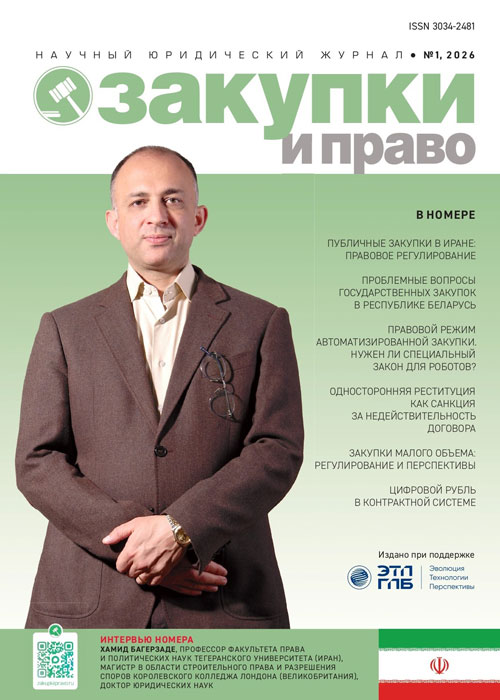
The article examines the main provisions of Iran's public procurement legislation, including the scope of application, threshold values (price thresholds), procurement methods, etc. The author pays special attention to the issues of financial support in the field of procurement, the procedure for concluding a contract, and the types of contracts. In the final part of the article, the author discusses the procedure for submitting and reviewing complaints from procurement participants, the grounds for conducting repeated tenders and canceling tenders, information support for procurement, and other related issues.
Keywords:
Iran, public procurement, government contract, procurement methods, financial support, cancellation of tenders
The article analyzes the legal nature and functional capabilities of the digital ruble in the context of the public procurement contract system. Based on current and planned regulatory acts, it examines the integration of the digital ruble into the budgetary process, the application of the funds «coloring» technology, features of treasury support, and identifies key problematic issues and solutions. The conclusion is made about the transformation of the digital ruble from a payment instrument into a mechanism of preventive control over the targeted use of budgetary funds, capable of increasing the efficiency of the contract system but requiring the resolution of significant legal conflicts.
Keywords:
digital ruble, contract system, Federal Law No. 44-FZ, Budget Code of the Russian Federation, «coloring» of funds, smart contract, Federal Treasury, Bank of Russia, legal conflicts, targeted use of budgetary funds
The topic of small purchases or so-called small purchases is currently particularly relevant in connection with the need to promptly solve tasks related to ensuring the needs of the country’s defense and state security, including achieving the goals of the Special Military Operation. The disclosure of this topic in this publication is based on the results of a comprehensive analysis of the content of federal laws No. 44-FZ, 223-FZ and 275-FZ taking into account the provisions stipulated by the order of the Government of the Russian Federation of 26.06.2024 No. 1636-r «On approval of the Concept for improving the procurement of goods, works, services to meet state and municipal needs of a small volume for the period up to 2027», as well as the role and place in solving these tasks of the «Automated bidding system of the state defense order» (AST GOZ).
Keywords:
state defense order, closed electronic procedures, small purchases, specialized electronic platform, unified information system
This article examines the issue of applying unilateral restitution when a public procurement contract is declared invalid. Despite the absence of a corresponding legal provision allowing for the application of unilateral restitution, courts have been increasingly doing so recently. The author concludes that this approach contradicts both the letter and spirit of the law.
Keywords:
public procurement, contract, invalidity of transaction
The article is devoted to the application of existing civil law constructs to automated and semi-automated business processes, including those implemented using artificial intelligence technologies in the field of supply chain management and procurement. In the context of the ongoing discussion on the creation of so-called “digital law”, it is necessary to analyze to what extent new legal institutions are actually required for the implementation of new business process technologies. It appears that, with proper analysis of the specifics of new technologies, the legal basis for the relevant relations can largely be found within the existing legal framework.
The problem of dishonesty and its manifestations in competitive methods of concluding a contract today is practically not studied. There is no mechanism for identifying and suppressing such offenses. The authors distinguish this type of dishonesty from unfair competition. The article highlights the main formats of unfair behavior at the auction, in particular: cartel conspiracies, nominal participation, evasion of concluding an agreement based on the results of a competitive method, submission by a participant of many applications to increase the price offered by him in the absence of consecutive applications from other participants, manipulation of the bidding mechanism. The authors consider cartel conspiracy at tenders to be an independent offense, different from cartels in the commodity market, and the use of special technical means at tenders is not qualified as unfair behavior of participants.
Keywords:
dishonesty, competitive methods of concluding a contract, cartel conspiracy at the auction, auction robots, nominal participation in the auction, register of unscrupulous persons, invalidity of the auction
The article, in refraction through the practice of appealing to the Ministry of Antitrust Regulation and Trade of the Republic of Belarus (the administrative procedure for protecting the rights and legitimate interests of potential participants and participants in public procurement procedures), examines the issues of ensuring access to the public procurement market of the Republic of Belarus for residents of foreign countries, issues of confirming the compliance of participants with certain additional requirements for participants, as well as the joint application of sectoral legislation and legislation on public procurement. In the course of the study, the arguments are reasoned, and based on the results of the study, measures are proposed to eliminate emerging issues.
Keywords:
public procurement, complaint, requirements for participants, additional requirements for participants, industry legislation
The article examines the means of meeting state (municipal) needs, among which the author includes public procurement, nationalization, requisition, legal forms of public-private partnership (concession agreements, PPP agreements, special investment contracts, production sharing agreements, etc.), the return of state property (assets) from abroad, donations (including crowdfunding), etc. The author concludes that the Russian system of state (municipal) procurement is the core (central element) of the system for meeting state (municipal) needs, and all other means are its secondary elements. The task of the legislator is to create the common system of means to meet state (municipal) needs by analogy with the contract system in the field of procurement and the corresponding legal framework.
Keywords:
public needs, means of meeting public needs, public procurement, nationalization, requisition, public-private partnership, crowdfunding