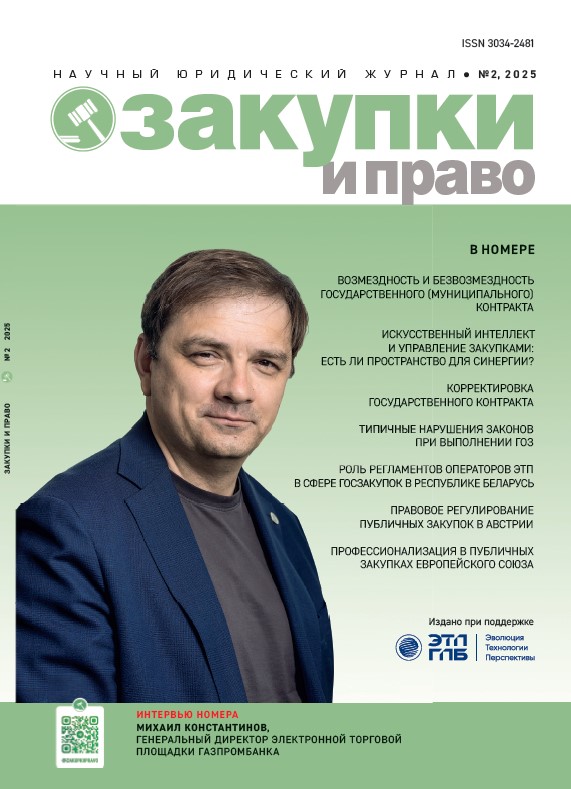
In order to conduct a comprehensive study of the legal regulation of information support for public procurement in Russia, an analysis was carried out of regulatory legal acts that provide for the use of the «information support» category in various spheres. As a result, the key features characteristic of information support were identified. A definition of the concept and the characteristics of information support for public procurement were formulated.
Keywords:
legal regulation of information support for public procurement, unified information system, electronic platform
The article analyzes the provisions of the Decree of the Government of the Russian Federation dated 03.06.2022 No. 301 «On the grounds for not posting on the official website of the unified information system in the field of procurement of goods, works, and services to meet State and Municipal Needs on the Internet information and telecommunications network information about purchases of goods, works, and services, information about suppliers (contractors, performers), with whom contracts have been concluded» for compliance with part 16 of Article 4 of Law No. 223-FZ «On Procurement of Goods, Works, and Services by Certain Types of Legal Entities», in the implementation of which it was issued, and some legal positions formed by judicial practice and applied by arbitration courts in resolving relevant disputes.
The author draws attention to the presence of contradictions/incorrect formulations in this normative legal act with such a minimal number of legal norms contained in it, which requires the development and adoption of legal response and regulation measures.
Keywords:
sanctions, restrictive measures, grounds for non-posting on the official website of the Unified Information System
The authors analyze typical violations of laws identified by the prosecutor’s office in the course of supervision over the implementation of laws in the implementation of the state defense order. Using specific examples from the practice of prosecutorial supervision, the focus of prosecutorial supervision on achieving the necessary coordination of the activities of customers and executors of the state order, the exclusion of desynchronization at various stages of the implementation of the state defense order is demonstrated. Based on the results of the study, the authors conclude that it is necessary to achieve the goals of fulfilling the state defense order at all levels of cooperation, including through prosecutorial supervision.
Keywords:
prosecutorial supervision, violations of the law, state defense order, military-industrial complex
Change of terms of contracts for supply for state and municipal needs in Russia today is generally prohibited (except for cases expressly provided for by law). In these conditions, even a justified change of the contract is often impossible. This, in turn, makes it impossible to supply high-quality goods, works and services for state and municipal needs. To solve this problem, the range of situations in which changes are allowed is regularly expanded. However, the solution to the problem of a justified change of the contract without excessive administrative procedures is impossible without a transition from casual regulation to systemic regulation of this issue.
Keywords:
public procurement, contract system, legal regulation, contract, change of contract, additional agreement
The practice of using artificial intelligence (AI) technologies in business relations makes it relevant to regulate the procedure for their use. One of the most promising areas for the introduction of innovative technologies today is public procurement. These procurements have long been carried out electronically. However, before introducing AI technologies, we must study the limitations of their use and identify promising areas for applying AI in procurement business processes. At the same time, it is important to avoid both the extreme of completely denying the applied significance of AI and the extreme of widespread implementation of AI as a panacea. The search for balance is focused on areas in which AI does not replace a person, but at the same time relieves him of the costs associated with routine operations. This allows a person to deal with expert issues, thereby increasing the efficiency of the authorized specialist.
Keywords:
law, regulation, procurement management, public procurement, digital technologies, innovative technologies, artificial intelligence, neural network
The article discusses the issue of the admissibility of concluding a «non-monetary» state (municipal) contract (with a price of zero rubles, zero kopecks). The author comes to the conclusion that it is acceptable to conclude such a contract from a theoretical and practical point of view. Special attention is paid to the question of the retribution (gratuitousness) of the contract concluded at the «auction turnaround» («going through zero»). The author comes to the conclusion that after «going through zero» we are talking not about one, but about two transactions: the first transaction is gratuitous, in which the supplier transfers property to the customer for free (at a price of zero rubles zero kopecks); the second transaction is a paid transaction, according to which the supplier pays the customer for the right make the first deal. The recognition of the possibility of concluding «non-monetary» contracts entails the need to amend legislation.
Keywords:
retribution, government contract, non-monetary contracts, auction turnaround, «going through zero»
Professionalization of public service is one of the most important prerequisites for policy continuity and, more importantly, for strengthening democracy. One of the areas that requires special attention to the professionalization of employees is the field of public procurement. Procurement activities carried out by various government agencies consist in offering citizens, with the support of private companies, the best goods, infrastructure and public services. Firstly, because such activities usually cannot be carried out directly by the state apparatus itself in proper conditions. Secondly, because in this way society is involved in the function of serving common interests that are not exclusive to the state apparatus and do not concern it alone. For this reason, procurement professionalization should be carried out not only by government agencies, but also, to a greater extent, by those who manage private companies, especially procurement departments.
Keywords:
public procurement, public services, professionalism, European Union, public interests
The article discusses the main provisions of the Austrian legislation on public procurement. The author gives a brief description of the sources regulating the relations under consideration (the hierarchy of relevant regulatory legal acts is analyzed). The list of relations that are and are not subject to the regulation of procurement legislation is being investigated (special attention is paid to price thresholds). The author analyzes the legal status and competence of key participants in procurement relations (customers, procurement participants, and regulatory authorities). The specifics of the use of various procurement methods, the specifics of the application of the principle of openness (transparency) of procurement are considered separately. The final part of the article is devoted to the application of legal liability for violations of procurement legislation.
Keywords:
Austria, European Union, public procurement, price thresholds, procurement methods, openness of procurement
The article examines the role of the regulations of the operators of electronic trade platforms in public procurement procedures within its electronic format in the Republic of Belarus, analyzes legal nature of such regulations. Based on the results, author argues the regulatory features in such regulations and their quasi- normative nature. The author identifies problematic issues in the public procurement sphere caused by the regulations of the operators of electronic trade platforms and suggests the necessity of theirs approval by the authorized state body for public procurement and specific rules to be implemented in public procurement legislation.
Keywords:
regulation, operator of electronic trade platform, public procurement